

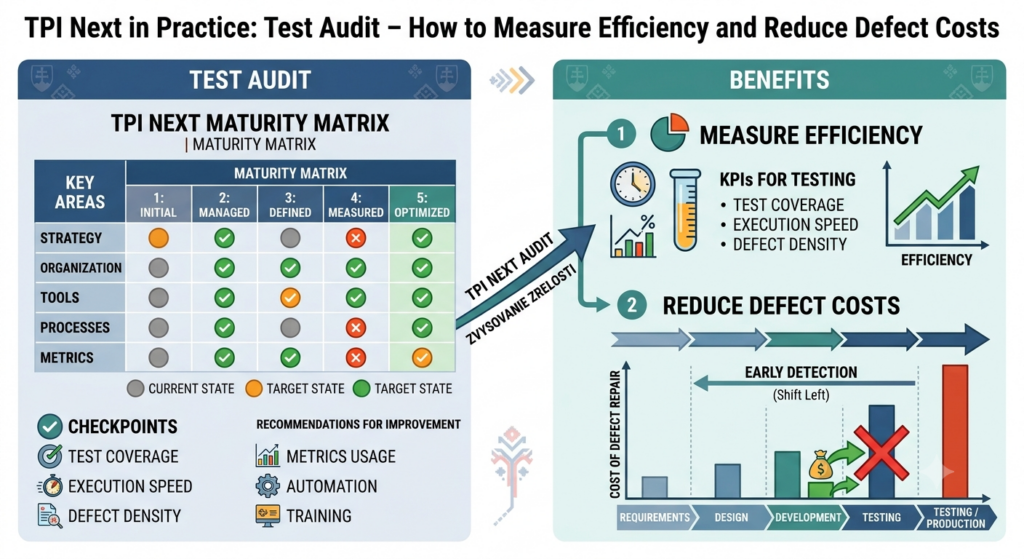
TPI Next in Practice: Test Audit – How to Measure Efficiency and Reduce Defect Costs
Introduction: When Inefficient Testing Costs More Than an Audit
In a corporate environment, a financial audit is taken for granted. Why should we treat IT any differently? The answer is simple: Software quality is a key company asset.
A Test Audit is a systematic review that ensures the health of your IT processes. It is not just about finding defects in the code, but a comprehensive diagnostic of the entire testing ecosystem. Ignoring the state of QA generates hidden costs and damages reputation. Therefore, a regular audit is an investment, not an expense.
Why a Test Audit is Crucial for Growth
An audit provides management with certainty and oversight. Key benefits include:
-
Cost Optimization: Identifying expensive licenses and unnecessary manual steps.
-
Risk Reduction: Uncovering critical business processes before defects leak into production.
-
Compliance: Verifying that QA processes comply with external regulations (ISO, GDPR) and internal guidelines.
-
Test Capacity Development: Assessing team skills and setting up a plan for the effective development of the QA department.
Methodologies: Why TPI Next is a Tactical Weapon
The success of an audit depends on the methodology. While models like TMMi/CMMI provide a strategic view of maturity, TPI Next is ideal for tactical changes and provides actionable outputs.
| Standard / Model | Primary Goal | Key Benefit |
| TMMi / CMMI | Strategic Maturity | Evaluation of position on a maturity scale, long-term vision. |
| TPI Next | Tactical Action and Improvement | Provides a detailed checklist for 16 key areas. Generates actionable steps for rapid improvement. |
| ISO/IEC 29119 | Process Standard | Ensures compliance with international testing standards. |
TPI Next: Why You Need a Tactical Checklist
While models like TMMi provide a great strategic view and define organizational maturity at a high level, they often lack detailed instructions on “what exactly to do on Monday morning.” This is where TPI Next (Test Process Improvement Next) comes into play.
TPI Next differs from maturity models by focusing on measurable and pragmatic improvement across 16 key areas. For each area—such as Test Design Techniques, Metrics, or Test Environment—it assigns specific checkpoints and clear steps to achieve the next level.
This is why TPI Next is a tactical weapon for management: At the end of the audit, you don’t just receive a report stating “low maturity,” but a prioritized task list with precise descriptions of how to fix the process. This minimizes debate and maximizes the speed of change implementation.
Audit Areas: What is Under the Microscope?
The audit focuses on four main pillars that form the testing ecosystem. The auditor’s job is to determine whether these pillars are balanced and effective.
-
Processes and Methodology: Checks not only the existence of a testing strategy, but also its practical adherence. If testing is Agile, the audit verifies whether testing activities are fully integrated into the sprint cycle (testing during, not after, development).
-
Tools and Technology: Analyzes the utilization rate of tool investments. For example, if an organization invested in an expensive automation tool but test coverage is only 10%, the auditor investigates why. It also checks the use of modern techniques, such as API Virtualization, which can significantly speed up non-production environments.
-
People and Organization: Evaluates whether team roles are clear and if staff possess the necessary skills (e.g., ISTQB certifications). Communication and the efficiency of information handover between QA, Development, and Business are also key.
-
Data and Environments: A critical factor for testing reliability. The audit verifies whether test data is realistic and if test environments mirror the production environment. Unstable or outdated environments are a frequent root cause of inefficiency.
Test Audit in Practice: 3 Execution Phases
The audit is divided into three logical phases to ensure relevant evidence is collected:
Phase 1: Scoping
Focuses on defining objectives, scope, and the TPI Next framework.
Phase 2: Data & Evidence Collection (Deep Analysis)
This phase is the most time-consuming as the auditor collects evidence on the state of testing activities across the entire organization.
A. Document Review (Desk Review): Which Artifacts Tell the Truth?
The auditor analyzes formal documents to determine whether defined processes actually exist. They look for alignment between what is written and what is actually happening. Key artifacts include:
-
Test Strategy & Plans: Is there a clear document defining when and what types of tests (functional, performance, security) are performed?
-
Defect Reports: What is the average time from defect discovery to resolution (Defect Life Cycle)? What is the ratio of defects found in QA versus those found in production (Defect Leakage)?
-
Metrics Reports: Does the organization measure testing efficiency? Are the metrics relevant, and are decisions made based on them?
-
Environment Specifications: Are test environments detailed, versioned, and is their status known?
B. Structured Interviews: Uncovering “Shadow Processes”
Interviews are crucial for understanding the reality of implementation. The auditor asks how processes are perceived and where people feel the biggest bottlenecks exist.
-
QA Team: “What is the biggest blocker preventing you from completing tests on time?” or “How do you provision test data for regression testing?”
-
Developers: “What is the quality of test builds you receive from QA?” or “What defect documentation do you need to resolve issues efficiently?”
-
Project / Product Managers: “How is testing scope decided under time constraints?” or “What does your Acceptance Testing phase look like?”
C. Observation: Reality Check
Observing tools and processes in real-time verifies whether claims align with practice. For example, observing how the team manages defects in tools (JIRA, HP ALM), whether fields are filled out correctly, and whether the defect lifecycle is followed.
Phase 3: Analysis
Compares collected evidence against TPI Next criteria and compiles a Findings Matrix.
Results: Classification and Action Plan
The deliverable is an Audit Report containing two main sections. The real value lies in the actionable roadmaps.
1. Classification of Findings – Resource Prioritization
Findings are sorted by impact to prioritize resources using a risk-categorization approach (Critical, High, Medium) derived from business impact.
| Category | Impact | Example of Critical Finding |
| Critical | Threatens Compliance, business continuity, or data integrity. | Complete absence of input data validation, exposing system security. |
| High | Significantly reduces efficiency or leads to a high rate of production defects. | Absolute lack of automated regression tests. |
| Medium / Recommendation | Optimization opportunities with lower immediate impact. | Irregular updates to test documentation. |
2. Creating the Action Plan: SMART Steps for Every Finding
Every critical and high finding requires a SMART (Specific, Measurable, Achievable, Relevant, Time-bound) corrective action.
Examples of converting findings into Action Plans:
| Audit Finding (Problem) | Category | Action Plan (Solution) | Owner / Deadline |
| Lack of integration point isolation for non-production environments (External API, Legacy system). | High | Implement an API Virtualization (Service Virtualization) tool for Module “X” covering 80% of critical interfaces. | QA Architect / Q3 2026 |
| Low test cycle efficiency due to manual re-deployments. | Medium | Establish a fully automated CI/CD pipeline for test environment T-02. | DevOps Team / Q2 2026 |
| Inconsistent test data leads to unstable automation results. | Critical | Establish and implement a production data anonymization (masking) process to build a high-quality, reusable test database. | Data Steward / Q1 2026 |
Key Principle: The Action Plan must be agreed upon by management, and resource allocation must be secured to ensure implementation; otherwise, the audit loses its purpose.
Continuous Monitoring and Sustainability
A Test Audit is not a one-time event, but the start of a journey toward continuous improvement. The true value of an audit emerges when implemented changes lead to measurable quality and efficiency gains.
1. Defining Measurable Key Performance Indicators (KPIs)
Improvement must be quantifiable. Each action plan needs set KPIs to demonstrate if corrective actions are working.
-
Reduction in Defect Leakage: The most important KPI. Measures the percentage of production defects that could have been identified during the QA phase. The goal of the audit is to minimize this value.
-
Test Cycle Speed: Measures the time required to execute an entire test cycle (e.g., time from code delivery to final report). If API Virtualization was implemented, this metric should drop significantly.
-
Automation Coverage: Tracks the increase in the percentage of test cases run automatically, directly reducing manual testing costs.
-
Mean Time to Resolution (MTTR): Tracks team efficiency in resolving defects. A higher quality reporting process (a result of the audit) should lower the MTTR.
2. Regular Reviews and Re-Audit Cycle
To ensure long-term sustainability, the audit should be repeated at regular intervals (recommended every 12–18 months).
A re-audit:
-
Verifies whether previous action plans were implemented.
-
Evaluates whether regression occurred (returning to old habits and inefficient processes).
-
Helps the organization move to a higher maturity level and embed a culture of Continuous Improvement.
Turn Findings into Growth
A Test Audit is not an inspection, but a strategic tool for growth and stability. It provides transparent insights and turns inefficient spending into meaningful investments. By using a detailed methodology like TPI Next, a list of problems is transformed into a concrete, measurable Action Plan.
Do you need an objective, external perspective and expertise across industries? An independent Test Audit is the first and most vital step toward establishing a stable and reliable approach to software development.